Showing posts with label snyder batman. Show all posts

Monday, September 27, 2021

The Batman Who Laughs by Scott Synder issue #6-7


This review covers both the last issues of the series.

The Batman Who Laughs, in some ways, could have been an interconnected arc to The Black Mirror, which was the previous collaborative work for a Bat-title between writer Snyder and artist Jock. Perhaps they've always intended it to be that way. In fact, a few of its elements had seeped into the narrative of BMWL including James Gordon Jr. himself, the primary villain for TBM. As I look back on all the seven installments I've read, I must say that there were glaring missteps that, to me, held back the series from becoming a full-fledged amazing Batman standalone story. The supposed core of The Batman Who Laughs is reminiscent to Darwyn Cooke's shorter work entitled EGO. I believe TBMWL delivered a hefty serving of a rather intimate psychological horror in which Batman came face to face with his worst self (literally and figuratively) in this hybrid of nightmares and insecurities known as the titular villain. 

However, after finishing all the seven issues, I found that overall production of the story underwhelming (if not convoluted at least) for two reasons which I will cite separately below w in m respective sixth and seventh issue mini reviews.


ISSUE NUMBER 6


The penultimate issue was probably the most suspenseful installment that attempted to connect all the pieces found in the earlier issues while ensuring the suspense was both taut and smooth sailing. Ninety percent of the time, it truly was an outstanding exploration that was brisk and nuanced particularly when it came to Bruce Wayne/Batman's tenacity as an individual. We see the inevitable unraveling between Batman and his worst self page after page of visually striking panels that conveyed the horror in bold strokes that bleed red.

Regardless of my reservation and nitpicks about the series, I will say that a lot of these illustrations are atmospheric in such a cinematic way that from the final rating I'd give The Batman Who Laughs out of 10, the four stars of that solid 7 belongs to the art of this comic book. I have my reasons why I think the art outweighed Snyder's narrative, which I'll touch upon now.

This story was immense in the scope it tried to embody which was essentially more psychological than the fanfare found in other titles since no other comic book superhero ever created can carry the weight of something like this than the the Dark Knight Batman. His very mythos and history had time and time again covered archetypes found in both noir and gothic literature. Batman stories can become not just detective stories but also ones that are steeped in psychological suspense and a dash of superlative horror if and when said standalones land in the hands of talented writers and artists. There's a reason why DC movie-verse seems so obsessed manufacturing the same gritty atmosphere that only really flourishes in a Bat-title, forgetting, of course, that such a macabre flavor is unique to the Dark Knight alone among all DC character. You can easily see Bruce Wayne/Batman jumping into Vertigo titles, which I believe did happen in stories I can't recall at the moment (like that one with John Constantine). But I digress. 

What I believe was the missing ingredient that would have elevated The Batman Who Laughs into another classic was the diminished portrayal of its titular villain. After seven issues, BMWL was utterly one-dimensional. Not once did I feel he was that big of a threat to Batman save for the dark alternate reality he supposedly embodies; this twisted image that married the Joker and Batman in a depraved shell that only knows how to deceive and win. But I never connected with him at all as a reader, which is the point of any horror story. Readers must be invested in the fears and risks that characters face and must resolve, or feel either dread or relief when the characters were changed at the end. There just wasn't a lot of that for The Batman Who Laughs.


HIGHLIGHTS OF THE ISSUE: The parallels between scenes for BMWL and Batman, and the Gordons and the Grim Knight are incredibly layered. As Batman struggles to hold onto his sanity with Alfred on the comms urging him never to give in or give up, Jim Gordon is confronted by the Grim Knight in regards to how he really feels about his psychopathic son. What I found most interesting for the latter scene was that it definitely feels like the encore for the finale in The Black Mirror. James Jr. has been fractured a long time, and some might say his disease of the mind and heart is incurable. The confrontation revealed that perhaps his own father was beginning to believe that, and his lack of faith that his own progeny can overcome the nature of his Beast was quite heartbreaking, far more so than the push and pull between Batman and his worst self. Still, there was a correlation between these scenes.


RECOMMENDED: 8/10


ISSUE NUMBER 7


The second reason I thought held back this entire series from being a classic was the overreaching plot point about the Last Laugh and infecting Gotham citizens with toxin (?) that would transform them into the worst versions of themselves. Isn't that the plot adapted from a fairytale written by Hans Christian Anderson? Because I'm pretty sure I watched that same kind of storyline unfold in one of the seasons of ABC's Once Upon A Time. It felt as if Snyder fell back on what he knew best, because he used this at least three times in his original run for the flagship Batman title, and they worked in their own way with a few deviations. 

However, that same shit shouldn't roll for this one too. That was a nitpick of mine that could have been scrapped during the cutting floor. It felt so unnecessary and only dragged down what could have been a mesmerizing and intimate exploration of Bruce Wayne's ongoing damage and Batman's endurance in spite of the trauma and pain of the boy nobody saved until he became a man who must do it for others in the shadows. What should have been expanded some more are those alter Bruce Waynes. As the story was concluded, those other Bruces felt to me as if they died dishonorably, their legacies untarnished. I suppose that was the point BMWL wanted to make when he murdered all of them, but it never went beyond the cheap thrill and shock value of seeing these better, more successful, more proactive, happier versions of Bruce Wayne cut down. They became nothing but collateral damage to a strife as old as time.

I would give credit to The Batman Who Laughs for the way Snyder and co. depicted Batman's tenacity against his own darkness because it had been a fun ride. The action was pulsating every page but the unfortunate byproduct of that was how any other meaningful points in the narrative and development had to take a backseat. Characters didn't exactly flourish where the main hero and villain are concerned, but at least we got to wrap up James Jr.'s arc from The Black Mirror which was a gratifying spin-off.


I may read the accompaniment oneshot featuring The Grim Knight since it is included in the story's seven issues so it's sort of like an interlude. In any case, even though The Batman Who Laughs had a few missteps, the vision and scope of its story remained ambitious. Visually, there's also a lot to feast on for every issue, thanks to Jock and co, but as far as the narrative goes, I think at this point I expect more from Snyder if he ever wrote another Bat-title some time in the future.


RECOMMENDED: 7/10

Monday, September 20, 2021

The Batman Who Laughs by Scott Synder issue #5

Now that I'm five issues into this seven-part mini series, I feel confident enough to say that this might not be a favorite Scott Snyder Bat-story. It's possible that my full appreciation is impeded by the fact that I've been so out of touch of Batman comics for the last five years. If I were to be honest, a lot of the content here felt as familiar as it is too comfortable for me. I acknowledge that Scott Snyder will always be one of the three writers that made Batman s enjoyable, nuanced, and thrilling for me. 

But for this title? A lot of it makes me think about his earlier stories when he was still the head writer of the flagship title that was DC's Batman. It borrowed a lot of the elements I recognized from his previous arcs as well as Gates of Gotham and Black Mirror. I suppose I could always view it as a pastiche of Snyder's own mythos which he cultivated and crafted as far as 2011, but is that all there is to The Batman Who Laughs? A collection of formulaic elements that he's already explored and became known as?

There are few nuggets of brilliance that had occurred in the five issues, honestly, but it's in this next part of the narrative that made me feel even more disconnected than ever before instead of feeling as if I'm about to solve a mystery or peel another layer of intrigue and mystery that was the metaphor and significance of Batman as a caped crusader. Is it possible that I have grown Batman/Bruce Wayne himself? I would hate to turn this review into an existential analysis of my overall relationship to this fictional character, but I supposed I might need some soul-searching about what Batman still means to me now that I'm in my thirties.

Save for the abandoned run of Tom King's early issues back in 2017 when I did take an unexpected hiatus, I'm not comfortable not thoroughly finishing what I started, which was why I wanted to pick up from where I left off and resurrect this blog. But after the initial rush of the past four weeks has now dispersed, it made me rethink of how I'll approach my next batch of reviews before the year ends and a new one begins. The truth of the matter is that after this one, I might combine my reviews for the last two issues of TBMWL. And that format may be more doable for me with other titles found in my Comics Shelf. It's simply not feasible for me to do reviews of individual issues, no matter how much I want to keep up with the new stuff soon.

So, a couples things first. Snyder and co. delivered something that was familiar territory for me, based on the kind of themes he and the artists had touched upon during his flagship run. That said, the interactions for this fifth issue are pitch perfect, if you were invested enough to see the terse interplay among Bruce Wayne/Batman of our universe versus BMWL and the Grim Knight. I'm still unsure how to fit the Gordon father and son add to it, aside from the far too on-the-nose association between them and the Waynes, but they're there along for the ride anyway. Once again, Snyder revisited what Gotham means to Batman, and what Batman means to Gotham and everything caught in between that push and pull relationship. It's a wonderful concept that fueled Synder's original run, and one that I ate up alongside many fans; we cannot separate the city from the Dark Knight and vice-versa.

Too many times we neglect the setting in which stories operate, but the most classically oriented novels that made an impact in history has treated the setting as another character to root for and sympathize with, and this is precisely what Snyder did for Gotham City. So what did Gotham City symbolize? How does that connect to Batman and the crusade he was fighting for? What happens when everything he believed was real and true about the justice he safeguards to protects its citizen had been nothing more but a delusion?


The notable thing I want to bring up next was this sideline plot device to the overall narrative of The Batman Who Laughs, which would be the trail of dead Bruce Waynes. If I'm recalling the order correctly, the first one featured in the morgue was a Bruce Wayne in an alternate reality in which he married, had a family, and was happy. The next one was a Bruce Wayne who was a politician who made a real difference in the city through bureaucratic channels; then we get one who was in competition with the Penguin's criminal enterprise and then another who took over Blackgate Penitentiary. Now, for this issue, we have a Batman who became the leader of the Talons of the Court of Owls. I don't know if anyone else saw a pattern here, but I believe BMWL ranked the best to the worst alternate Bruce Waynes here, including himself and The Grim Knight who are the extremes of the spectrum.

Now I'm not really sure what that entailed, and what it could all mean in the grand scheme of things, but it was fascinating to me, much more so than the plan BMWL has in which he made Batman lose hope in himself, the city and everything else he stood for. That's how this issue ends, on that not-so-original cliffhanger. With a lot of things running in the background, this major revelation was a tad underwhelming. Like, really? Gotham is not a beacon but rather the darkness itself? Can't imagine why. It is a violent and corrupt city where the most rutheless and depraved of killers and criminals exist. How could it be anything else but a bad place? Because Batman's there? Hell, Batman can be viewed as the bad guy who has to give it worse so the the worst monsters will keep in line.


I don't really know what to do with that last few pages. For issue #4, I commended the visuals team for the tireless and creative delivery they've achieved for this title. However, I feel as if they may have overdone it here and missed the mark. Some of the panels put a strain in my eyes as I read on. Too many details are going on in certain scenes but also sparse on the parts in which detail does matter. I am also getting sick of BMWL. I'd take DCEU's the Joker played by Jared Leto at this point because I am not entertained or interested in him as a villain. Maybe the Grim Knight should have had the starring role instead of playing lackey.


RECOMMENDED: 7/10

Sunday, September 12, 2021

The Batman Who Laughs by Scott Synder issue #4

Infected with the poison from the Joker's heart, Batman had been gradually giving in to the darkness that was always there, lurking in the fringes of his well-cultivated sense of control. It's the pinnacle of the Abyss Staring Back.

This installment from a very splendid mini series written once more by my favorite Bat-writer gave us more than just a few passing glimpses; instead it took us through an unnerving journey that was greatly supported by one of the best visuals I had seen drawn for a single Batman comics issue to date.

My reviews for the previous three issues substantially tackled Synder's writing chops. The man does know how to write compelling exposition, and more so for dialogue. All the Batman issues he's written have chock-full of glittering examples, regardless if there were inconsistencies in the plot.

However, at the risk of sounding repetitive at this point in time, I instead would like to review the other equally important side of a comic book issue which are the visuals. The synergy among Jock, Baron, and Cipriano was fully realized for this installment in particular. While it's possibly ninety-percent leaning on text blurbs since the dialogue for all scenes served to push forward the developments of the second half of the story, it wouldn't have worked if it wasn't for the engrossing art. 

I more than appreciated the use of red for some panels, especially since it conveyed effectively the state of mind Batman/Bruce was undergoing as the toxin has spread across his mind. It's truly horrific to watch him lose sense of reality bit by bit each time he looked at those he loved and cared about such as Alfred and--to a lesser extent--the ordinary folks of the city he wanted to safeguard. The metaphor for this issue, too, talked about how Bruce often tried to see the world through 'the eyes of children' or the innocent whenever he felt discouraged or too fatalistic. 

That was why the opening pages had Dick Grayson as the first Robin swooping down happily in the Gotham cityscape in all his bare innocence. But this time such an attempt to utilize the same practice was failing, since Bruce can hardly differentiate between what he truly sees and what the toxin wanted him to see. And the images are frightening, splattered in red and chaos. The notable adoption of the same visor BMWL wears made me uncomfortable; Bruce reasoned out it was a way for him to see what his enemy sees, but methinks it's just another manifestation of his dark side slowly taking over his defenses. But much like Alfred, I am placing my faith that Batman/Bruce can survive this. He's proven himself strong where lesser men are their weakest.

Red yet again was used to differentiate the text (courtesy of Cipriano) wherein certain terms or phrases were color-coded like that to indicate that Batman/Bruce was slipping while he's talking. After all, BMWL's own blurbs are colored purely as red, which I haven't noticed until now. He and the Grim Knight had abducted James Gordon, because he was Batman's 'best friend'. The Grim Knight doesn't share the sentiment, however, because in his world, the Commissioner was the one adversary that kept getting in the way of him claiming victory as a caped crusader. Going back to the well-known saying of how the Abyss Stares Back, it's also aligned to Synder's recurring metaphor of seeing things through 'the eyes of the innocent', which was twisted in this case.

The climactic confrontation in Blackgate was my favorite scene. The second would have to be Batman's quaint temporary 'truce' of a sort with the Joker. The installment ends with a grand soliloquy from BMWL which hits the right notes when he claimed, "You're trying to see things through the eyes of your Robins, aren't you? Through the eyes of your so-called children. But they knew, Batman. The hope you saw in people, it was a lie. That's why Dick, why all of them, stayed high above. Yes, the hard truth is you're finally seeing things clearly. Because of the first time ever, you're looking at Gotham through the eyes of your real child..."


I don't know how James Gordon and his son would play into this, but I have a feeling it has to tie up with the ongoing parable between Batman and his darker alters. It's worth mentioning that there's a Grim Knight oneshot that's connected to this, so I might have to look for that and read. Overall, this was far more impressive than the previous issue which I have a few nitpicks in my review. The loose ends were being tied up here while it also has more room to surprise readers yet again. 

Two more issues to go before The Batman Who Laughs hopefully wraps up amazingly.


RECOMMENDED: 8/10


Saturday, September 4, 2021

The Batman Who Laughs by Scott Synder issue #3


Much like the last two issues, we open with yet another flashback; this time it was a familiar (if not already iconic) scene when a young Bruce Wayne fell in a hole and encountered bats for the first time, prompting his phobia for them. It was a monumental moment for a child, who will one day become a caped crusader, overcoming primal fear of the dark and unknown. Thomas Wayne was quoted saying, "See it in your head, Bruce. See the rope, see yourself climbing out, see yourself being brave." 

This act of visualizing carried on as the boy became a man and then the Bat. Bruce stressed that this was how he learned to build on plans especially contingency ones. More than the trauma of seeing his parents killed at gunpoint in one of the alleys of Gotham, or seeing a bat sweep across the window of his private chamber, the memory of being trapped down that hole and hearing his father's voice to be brave, to imagine getting out and then doing it--that singularly propelled him to daring heights as the Dark Knight. It's all about being ready and having plans to outwit and outmaneuver the most intelligent of his foes.

After all, what's a predator without its habits? Batman wasn't just a brute force hammering down on thugs; he's also a well-trained sleuth with a keen eye for detail and patterns in the crime. This time, however, certain things elude him. And when he's fighting a toxin slowly pumping madness into his veins, Batman definitely has a lot to overcome for this story arc alone. He would need a little help from his friends.

Speaking of allies, Commissioner James Gordon set out to find his son, a confirmed megalomaniac psychopath that bore his name. James Jr. has been institutionalized and carefully monitored for years after he was revealed to be nothing like the man who rasied in. James Jr. was sadistic and merciless and at some point during The Black Mirror arc, he even wanted to poison an infant nutritional facility. Because, you know, if you want to prove you're one malicious sick fuck, you always must go after the innocent children. This issue featured a more mellowed out J.J, however. He didn't try to reverse his medication anymore to 'increase his psychopathic tendencies' while he's...I don't know, a clerk in some shop, in charge with packages? 

It didn't matter to his dad; at this point, Commissioner Gordon has given up hope that his son can ever be cured. His psychopathy can only be prevented through his medication and a current banal routine, but he was still never going to be the young man his father hoped would inherently pursue goodness. That didn't mean James Sr. would diminish the real progress his son made, even if meeting said young man was only possible right now because Batman required J.J's knowledge of the city's hidden pathways that BMWL and the Grim Knight are after. To be honest, I don't know what James Jr. is even doing in this issue aside from the fact that Snyder and Jock featured him on their previous collaboration. In the end, the Grim Knight wanted the commissioner, not his son. After all, it was stated in the last issue that Batman used his DNA and that of the other older man whom he trusted aside from Alfred. I actually lost track of the story's momentum because this issue also has another cameo appearance that I felt run on for too long that necessary.

I'm talking about the Penguin. While it always delights me to see Oswald Cobbleplot hobbling his way into the pages to be an utter nuisance of a menace, I didn't see the point of BMWL having that big monologue explaining to the readers that another version of Bruce Wayne became rivals with Cobblepot instead of merely stopping said crime lord's illegal activities. In the end, BMWL made yet another example of this Bruce Wayne much like with the others. Is there something particularly more significant to this Bruce alter than the last two? Are we going to see Penguin again later? That goes the same for James Jr.? There are only four more issues left for this series, so anything could happen, and there may be a lot more in store. However, with this break in the main narrative that contributed nothing except some action sequence whose violence felt somewhat lacking, I daresay this issue is the weakest instalment so far.

The plot was definitely meandering for this issue. What saves it from being completely dull of a read was the grand reveal at the end which supposedly has to be a game-changer, and I want to see what direction Snyder wants to go for. Not only has Batman succumbed to the toxin, but the Joker got away from Alfred's operating table in spite of all the sedatives. With the Joker, he always requires even the most pragmatic of readers some hefty suspension of belief. I can excuse Joker once more eluding capture because he is not a man of flesh and bones but more of a mythic bogeyman. I think it's fair at this point to subscribe now to that belief.


In spite of how underwhelming the overall content of this installment, I'm still looking forward as to how this all ties up and how exactly Batman plans to visualize himself climbing out of this clustefuck of a hole.


RECOMMENDED: 7/10

Monday, August 30, 2021

The Batman Who Laughs by Scott Synder issue #2

Much like with the first issue, Snyder opened with yet another metaphor concerning the functionality of hearts and the sentiment that Bruce has infused it with while he recalled the last action his father Thomas Wayne ever did seconds before the man was shot to death--he covered his son's chest on instinct where the heart dwelt. Poetic prose like this lives on in Synder's other comics, and his Batman deserved such poignancy too, considering that more than the standard fanfare of a superhero comic book, Batman was also always the story of a fractured man whose privilege and trauma go hand-in-hand as he pursued a dark path to become the beacon of justice in a very violent city filled with disturbed individuals who often bled from the same vein as his own grief and slice of madness.

This second issue picked up immediately after the previous one's final moment, with Alfred operating on the Joker's heart where the toxin supposedly was released and infected Batman. Meanwhile, an understandably sluggish Bats (who was doing his darndest to curtail the spread of the toxin by injecting an array of syringes bearing antidotes) convinced his butler and most loyal friend not to even think about allowing the Joker to die, as tempting as that sounds. With deadly poison coursing through his body, he still went to work like the champ he was, disguised as Harvey Bullock, to talk to Jim Gordon. Yet another Bruce Wayne was killed, this time thrown from several stories up in a Building That Doesn't Exist, at least not in this version of Earth. This Bruce Wayne became Mayor after the death of the second Robin Jason Todd. 

The working theory was that Batman Who Laughs had been picking out different Bruce Waynes from several intertwining universes to make a point to our Earth's Batman. He also brought along The Grim Knight, the Earth-22 Dark Multiverse version borne from when a young Bruce Wayne picked up the gun in the alley and shot his parents' killer with no remorse. That's why this Bats has no problem carrying firearms, something we all know Batman has always been against. Because I was missing this context from the last issue, I actually thought they are the same twisted version of Batman, but no, The Grim Knight was an ally of BMWL, acting as reinforcement. Someday, I'll touch upon this Dark Multiverse storyline across Bat-titles. Like I said, it's been five years, and I'm a bit rusty now that I haven't kept track of things. Moving on...

Batman would then share to Jim Gordon something called the Last Laugh. Apparently, the founding families of Gotham, after 1780 when a plague wiped out a third of the population in the city, feared that what they saw at the heart of the country could become the means to the infection. Just like your average Gothamite then and now, they decided to prepare for the worst, vowing never to allow Gotham to become the source of such darkness. That was how they set up a system called the Last Laugh. It's apparently a defense system "in which Gotham can be protected if anything terrible spread inside". Essentially, Batman installed something to that effect on Wayne Tower. It's a way of purifying the air in the city, restoring waterways and the overall health of its citizens independently. It can only be accessed through DNA, which would be Jim Gordon and Bruce Wayne's. Any Bruce Wayne, as it turned out.

BMWL and the Grim Knight entered the premises of the tower and went to work to disable the controls. It's worth nothing Batman was still under the influence of the Joker toxin which will turn him into BMWL if he didn't fix that shit soon, but he's got other concerns. Crime likes to multi-task after all. This below is my favorite set of panels because they harkened back once more to what Snyder opened up with regarding the functionality of hearts while also allowing readers to glimpse BMWL's twisted logic.


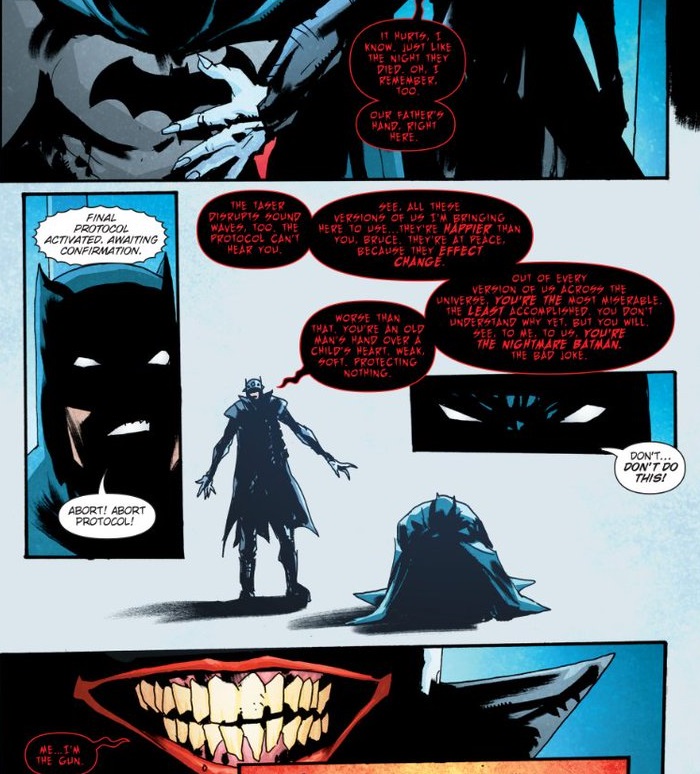
"You're an old man over a child's heart--weak, soft, protecting nothing." Well, shit, when you put it like that...

In his warped mind, he actually thought that he was doing Batman a favor by killing all these different Bruce Waynes and gift-wrapping them here in this Earth for some rude awakening. BMWL stressed that this world's Bruce Wayne/Batman was the least accomplished of all the versions of himself because he's caught in the same cycle unlike other Bruces who either chose to domestically be happy as a husband and father or politically effect change as a public servant. Hell, at least BMWL is...a social change crusader himself? In any case, he does make sense the same way the Joker's rhetoric often did if you stop long enough to stare into the abyss.

This mini series is slowly shaping itself to be another masterpiece for Scott Snyder, but it's only been the second issue so I will try to curtail my expectations. I have four more to go and I'm looking forward to reading and reviewing within this week!

RECOMMENDED: 9/10

Sunday, August 29, 2021

The Batman Who Laughs by Scott Synder issue #1


My gateway to Batman comics was during The New 52 when Scott Snyder became the head writer of the series. Considering the mixed bag that was New 52 in general, I barely could even remember the specifics of what made it great or bad because all I cared about was the main title and the accompanying Bat-related ones in the roster for that run. It seemed befitting then that I come back to this blog again to read and review his 2018 series, The Batman Who Laughs which he also collaborated with the artist Jock. This is exciting for me because I cannot stress enough how much I loved The Black Mirror, their previous collaboration. And since I have no idea what's new with DC nowadays, my review of this series may lack some much needed context, but I will try to compensate by giving enough insight as I could based solely on appraising The Batman Who Laughs as a standalone.

The most gratifying thing where Synder's writing is concerned will always be his deft ability to weave immersive narrative. From the very first pages in which Bruce Wayne asked the reader what they recall was their earliest happy memory, Snyder also managed to set up ambiance and theme, elements which would play throughout a single issue and possibly for the rest of the arc itself. Jock's phenomenal art is complementary of the prose, and the skill in which he could draw can be found during the car chase scene, the exposition's opening action sequence that was engaging from start to finish.

I've pointed out in the past, however, that Synder has a tendency to chew the scenery too much as well. I recall certain issues from his arcs in his Batman run in which he indulged in exposition for way too long that the text overshadowed the sequences of the panels, rendering the visuals almost static in contrast to the words. But for the first issue of The Batman Who Laughs, it's never been more clear how much writer and artist understand each other's styles and how best to work around their flaws so that they could bring out their strengths together for each page.

Something that struck me in a lot of Synder's writings for Batman and Bruce Wayne was how frequently he employed horror tropes, particularly Batman as a noir detective. As much as I also enjoyed the colorful flamboyance and utterly insane stories that Grant Morrison have penned for titles like Batman Incorporated and his run for Batman and Robin, I think I still much prefer the disquiet and gloom that permeate in Synder's overall version of the Dark Knight since it's able to distinguish itself from earlier works post-Frank Miller era by not parroting the morbidity of said content. What we have in his version was a Batman that still clings to a more hopeful message of overcoming personal adversity in a city that time and time again could destroy you, and yet said destruction can also yield, even bloom, worthier developments in its people and the home it embodied.

In The Batman Who Laughs, certain pages delivered on the atmospheric horror mainly because Jock knew how to make each panel look subtly sinister. There was that moment in the morgue where a disguised Batman was examining the cadaver of his alternate self who made different choices after Bane broke his spine. But it's not all gloominess either; there was also that lighthearted banter exchanged between Batman and Alfred as they investigated. It made me feel safe in ways that were nostalgic and far too familiar, as if the dialogue was written to reassure me these are the good guys who will always save the day. Nothing felt forced about it, and when the twist midway leading to the cliffhanger came, it was even more bittersweet to look back on the lighter moments of the issue, such as that opening regarding a young Bruce and his parents playing a game. Synder has connected the thematic resonance of those earlier panels with that of the disturbing revelation on the last page.

But what is The Batman Who Laughs? He was apparently a Batman who went insane after he killed the Joker. There was a toxin released in the Joker's body which drove him mad, but he would also have the same memories, abilities, and level of intelligence, all while bereft of the moral code and values he had lived by as a caped crusader. This Batman (also known as 'Metal') was simply concerned less about imposing righteous justice but more about winning. It's a terrifying hybrid of what Batman never chose to stand for and what the Joker dreamed of in his most twisted, wildest fantasies.


To be honest, a lot of the premise that still eluded me, but I'll gladly chalk that up to the fact I'm a little rusty reading and reviewing Batman comics. Hopefully, I will have more substantial stuff to say for the next issue. I know this mini series only has six, and I intend to finish them even if reviews might be slow due to other commitments. I may resurrect this blog this year with more consistent material, such as following up on my readings of Tom King's run for the flagship title, but there are no guarantees.


RECOMMENDED: 8/10


Sunday, April 30, 2017

All Star Batman by Scott Snyder issue #8


The original plan was to review the next two issues in Tom King's Batman run, yet issues #8-9 were co-written with another writer named Steve Orlando which was all about the Night of the Monster Men. This story arc was a crossover which meant that certain installments appear in other titles like Nightwing and Batwoman. And I had no real interest to read this arc completely which was why I decided to do away with it and officially end my Batman comics diet for this April 2017 on a Snyder issue about the Mad Hatter for the third chapter of Ends of the Earth. If there ever were any good Jervis Tetch stories out there, this might be one.

It's rather difficult to fully describe the experience of reading this issue. The narrative itself was written in the stream-of-consciousness style where Batman became prey to a rabbit-hole mind fuck courtesy of the Mad Hatter. The result of which is an odd and brilliant mixture of elements that paid little homage to Lewis Carroll's Alice stories as the inspiration while also still holding itself as its own standalone topsy-turvy. With splendid illustrations by penciler Giuseppi Camuncoli, inker Mark Morales, colorist Dean White and letterer Steve Wands, this third installment for Ends of the Earth truly is a fascinating feast for the eyes.

Mr. Freeze released a pathogen that attacked thousands of people who lost their lives in the process. Ecologist Pamela Isley (also known as Poison Ivy) agreed to give Batman a cure to prevent further casualties. But Batman, being Batman the ever vigilant, still wanted insurance that the pathogen will not grow again and infect more lives, so he goes to a residence where he encountered a formidable threat. Back in the early beginnings of Zero Year, Jervis Tetch had approached Bruce Wayne about a certain project and it would seem as if he had possessed the same strain of virus which Mr. Freeze years later. 

That's why Batman followed this lead all the way back to whom he thinks is the source. There was still a matter of the Blackhawks, though, who are a unit of mercenaries seemed to determined to get in Batman's way. They even disguised themselves as the Bat-family, and Batsy was having none of that and managed to unmask the pretenders. One scene of it was done in a rather comedic way, with Batman using a mechanized flamingo to slam against the fake Nightwing. It was easily one of the most spectacular things I've seen in comics! So anyway, Batman goes down a rabbit-hole and things just get plain weird.


As I've said, the uniquely rendered illustrations and the overall composition of the art for this issue was refreshing and visually appealing. The four artists who have collaborated in this really showed quite the craftmanship. Each panel sequence was dream-like and insane, and readers just don't know what is happening but they are nonetheless mesmerized which was even strengthened by Snyder's subtle and often enigmatic choices  of narrative and dialogue. You are seeing everything but not understanding what it is as well. The issue ends ambiguously too. We don't get immediate resolution just yet, such as Duke Thomas being captured by the Blackhawks, but that makes me look forward even more for the next installment. It may not be a straight-up ghost story ambiance like the Mr. Freeze issue but I found certain parts of this issue...unsettling. And I really like it.


The next chapter for The Cursed Wheel is still a slow read but I think that this might be all a set-up for something I hope would be fulfilling much later on. Duke Thomas is starting to be sympathetic for me too which is probably a positive highlight for me at this point. A very splendid issue, the third installment for Ends of the Earth should make readers crave for more.


RECOMMENDED: 8/10

Friday, April 28, 2017

All Star Batman by Scott Snyder issue #7


First and foremost, the extent of how Poison Ivy was depicted for this issue alone was incredibly positive, partly because of how careful Snyder was in writing her dialogues and mostly due to the beautiful illustrations drawn by artist Tula Lotay who made Poison Ivy at least visually less lewd and sexually charged than most more modern comics have been shamelessly parading her as. The sensual and classy version of Poison Ivy is something I remember watching and enjoying in the animated series which was why any other take on her sexuality that is often too much of her defining trait is something I tend to steer clear away from. 

Aside from being one of the memorable Bat-villains from the Rogues' gallery, Poison Ivy embodied female sexuality like no other fictional woman in comics, I believe, because she's also intimately connected with plant life ergo nature itself so she became unavoidably a conduit for everything feminine in its supposedly most empowering form. Nevertheless, she was still portrayed as a villain most of the time; a grand seductress with vengeful, reactionary tendencies towards anyone, especially men, who would abuse and trample on the environment which often put her in the role of a simple eco-terrorist. She cares so much about nature that she was willing to sacrifice humanity, her own race, either to sustain or improve plant life in earth.

That's her deal and to achieve writing her as a nearly sympathetic character can be a challenge for writers, and one that Synder attempted for this issue and actually succeeded, in my honest and humble opinion. The second installment of Ends of the Earth is a slow read and quite substantially just as expository as the first one with Mr. Freeze though this one also has many dialogues and discussions between Batman and Pamela Isley (Poison Ivy). Action also occurred less here and only one confrontation at the closing pages happened. Overall, the main story dealt mostly on Batman appealing to Isley to help him contain the epidemic that Freeze spread last issue. He sought her aid by personalizing it for her by telloa young girl aspiring to be an ecologist just like Isley but whose contact with the disease and subsequent death with label her only as the carrier and nothing else.


Isley, of course, would take issue on that, sympathizing with said girl but had at first didn't show it just so she can put up a strong front before Batman. What I really enjoyed about their simple yet nuanced interaction is that Batman genuinely believed that there is goodness in Isley that he knew he can connect with and even rely on, as well as the fact that he was willing to humble himself before her and admit to himself and especially to her that he cannot do this all alone and he expresses a desire to work with someone who has great knowledge about how to counter this viral attack, even if that someone is one whom the world considers nothing more but an antagonist, all for the sake of saving lives and avoiding more losses.

For the way their relationship alone was depicted for this second installment, I'm giving this issue high rating. As for the eight-paged backup story, there isn't much to say at all which was disappointing. Artist Francavilla wasn't also given that much material to work with so his usually great illustrations didn't strike as anything notable. I only liked one panel and it's about Duke Thomas and how his insecurities were spelled out by Snyder. I liked that brutal honesty at least.


RECOMMENDED: 8/10

Wednesday, April 26, 2017

All Star Batman by Scott Snyder issue #6


Snyder's five-chaptered arc My Own Worst Enemy which focused on Two Face/Harvey Dent had been an off-beat, kooky spectacle of an action-adventure story which had amusing hijinks and colorful sequences to match it as illustrated by Kick Ass artist John Romita Jr. It had been a wonderful ride with a rather neatly tied ending that made sense yet also not nearly as satisfactory as one would hope. That being said, I was ready to embark on Snyder's new arc which would have another Bat-villain as a focal point and this time it's Mr. Freeze. Imagine my gleeful surprise to discover that the artist for this issue is no other than Jock whom Snyder had collaborated with in one of my favorite Batman volumes of all time, The Black Mirror. 

The immediate change in the tonal approach for this issue's narrative (an atmospherically bleak and gothic vibe) was unexpected but most welcome on my end because this is the Scott Snyder I'm more accustomed to whenever he's writing a Batman story. Combine that with the staggering breadth of Jock's lingeringly creepy illustrations about ice and zombies and you got the perfect ambiance for a ghost story. There was nothing specifically paranormal going on for Ends of the Earth but it's also recognizably a Frankenstein-eque story. Mr. Freeze brought back to life dozens of cryogenically frozen people to do his bidding as Batman ventured to the Arctic Circle to hopefully put a stop to nefarious plans. At the center of it all was Nora, Mr. Freeze's beloved, whom he still wished to wake up someday. Batman tried his best to convince Freeze not to go through his diabolical machinations for the sake of the only person he had ever truly given a damn about. It's all very touching until one remembers something.

And that's no other than the fact that DC rewrote the backstory regarding this couple. In current comics continuity, Nora was no longer Victor's legal wife; in fact she was just a woman he was pining over and so this meant that the 'love' was unrequited on his end. And it's quite frankly a disrespectfully dumb rewrite of what used to be such a moving story about a desperate husband driven to desperate measures in order to save his wife that he was willing to cryogenically freeze her for a while until there was a cure for her disease. Nora was Victor's last piece of humanity; the only one who can possibly thaw the ice in his heart once she is awaken. To remove the 'married couple' dynamic from their story now reduces Mr. Freeze as nothing more than a deranged stalker willing to do whatever it takes to gain the affection of a woman whom he has no personal history with unlike in the story as featured in Batman: The Animated Series, Heart Of Ice. That remains to be hands-down the best Mr. Freeze origin story.

I don't know why DC rewrote what Victor and Nora had; I mean, at least the show Gotham had the decency to keep their marriage intact in their own version of Mr. Freeze's origin story. What I will tackle about instead was how Snyder managed to 'fix' this rewrite by claiming that in symbolic spirit, Nora is Victor's 'wife'. If you have no idea about the rewrite, this won't even register as an odd choice of phrase because I bet the version that most Batman fans know about Mr. Freeze is the one they have watched take place in Heart of Ice. Anyway, I like how Snyder wrote this issue strictly more in narrative form than in dialogues. The exchanges mostly happen in narration boxes so everything is expository in that sense. And I think it worked brilliantly, especially since Jock was the artist who brought to life some of the most creepy panels ever put in a comic book's pages. His art style has such a seething horrific yet subdued vibe that looking through them can give someone chills. 

That revelation at the end pertaining to how Batman duped Mr. Freeze was so out-of-this-world it was a proud mark of genius. Sure, it's disconcerting that Batsy would attempt something so fatal to his life but that's just part of how Batman usually operates so it shouldn't be that much of a shock. I definitely enjoyed this issue at last. I think it's the finest of what has come out from this title so far. I read that the next issues would be standalones like this one and would feature Poison Ivy, Mad Hatter and Ra's Al Ghul.

The second cycle of The Cursed Wheel story also fared better than I would have counted on. Yet another artist (Francesco Francavilla) managed to make it work. He had very interesting choices for panel layout and the visual impression that was created is one that for me fits the overall 'enigmatic' charm that is the Riddler. Much like the main story, this was relied on exposition which I had no problem with because it actually took the time getting readers into the story's fundamentals unlike the first cycle. Duke Thomas is once again the focal point of the story alongside the bad guy Riddler and this I hope becomes consistent because I'm slowly warming up to the idea of Duke becoming a part of the Bat-family and I'd like to see how he holds himself up to that pedigree. So in a nutshell, issue #6 had been a very impressive installment.


RECOMMENDED: 9/10

Friday, April 21, 2017

All Star Batman by Scott Snyder issue #5


The fifth installment of this series is also the conclusion to the My Own Worst Enemy arc concerning Two Face/Harvey Dent. And I liked it a lot, the way everything was tied up neatly, including the vital loose threads. For what it's worth, it's been an audaciously fun ride! Everything was fast-paced and the few parts that were humorous were campy and never bashful about being so. I liked the presence of KG Beast and the tug of war happening between Batsy and Two Face as well as Two Face and Harvey Dent themselves. But even with all the topsy-turvy shenanigans going on, Snyder still managed to deliver a character-centric story that has some impact, and it's in the moments he can craft that when All Star Batman truly shines.

This final piece to the Two Face arc was not perfect but it had brilliant markings. It held enough gravitas, sure, but if you start nitpicking at each layer you will come to realize that it was a flawed conclusion even though Snyder and co did a fine enough job with the landing. This series overall was offbeat and experimental which was why I opted to forgive some oversight and weak plot devices here and there, especially since this issue had a share of those. My enjoyment didn't lessen at all once I start inspecting these flaws because for the last four issues I was vigorously entertained and amused which means something. Snyder wrote a Batman story that actually made me giggle here and there, and in comparison with his grim and poignant run when he was still the writer for the flagship Bat series, this for me was a refreshing angle to experience concerning his writing for the character. 

John Romita Jr.'a art style is not for everyone, but for an action-packed and gimmicky adventure story with lots of fight sequences and landscape shots, his style worked pretty well to complement the punches that Snyder never hesitated to pull for every issue. The breadth of the illustrations for All Star Batman is remarkable; very dynamic and colorful and so easy to get lost in, most notably those lush flashback sequences about Bruce and Harvey's childhood. That unforgettable action scene on the train as well as the steamboat escapade for this issue were definitely easy stand-outs and Romita Jr.'s rendition of the scenes contributed to that memorable factor. I wouldn't say he's a favorite artist but I enjoyed the body of work he produced for this series alone.


That being said, I wanted to point out the increasingly unbelievable feats of physical strengths that Batman displayed for My Own Worst Enemy. The attacks he had to endure and soldier on have been massive and should have taken a toll on him, but Batman was still walking and kicking ass and I don't think that I can buy into that crap because Bruce Wayne is no Sups or Diana. He's a normal guy who has just undergone extensive training but even he should have limits. He has ruptured and fractured so many parts of his body so I don't understand how he can still stand up! At no point was this inhuman invincibility was addressed though, so let's chalk it up to simple oversight or casual negligence. It's not that important unless you dwell on it anyway. 

But I want to talk about the two dangling threads which were introduced in the first two issues then abandoned later on and finally resolved here in the last installment. I'm referring of course to the reason why Alfred shot the bat-plane in the first issue and why Gordon and the rest of the GCPD are in the Wayne Manor right now and  are apparently going to investigate a possible 'man-cave' underground. Both are consequential of each other as it turns out. Let me just show you this page of Alfred being uncharacteristically flippant and weird. Seriously, I don't recognize this Alfred. He's too easily rattled:


Gordon fared better, canon characterization-wise, because he got to me witty in those few pages he appeared in. His dialogue with Alfred subtly hinted that he knows Batman is Bruce Wayne but he's still tiptoeing around it for the sake of discretion and I like it because it shows Gordon is a competent and smart enough detective to figure out the real deal, but also upholds that he should keep Batman's identity a secret. So now we know why Alfred shot down that plane and then when the GCPD arrived underground, they didn't find the batcave at all but just some ordinary 'man-cave'. Gordon had a little laugh with that deception yet was relieved that Batman's secret gets to live another day. So those loose threads were tied up in a sort of anticlimactic yet acceptable way.

And now we come to the main event which was Two Face's treachery regarding the cure:


And Batman flipping the chessboard on him all along:


Good stuff. Two Face thinks he had the upper hand but Batman has it all along. I liked the angle that they were childhood friends but it didn't really contribute anything that meaningful in the story except maybe the fact that Bruce becomes privy about Harvey's daddy issues and how his abusive father would use a coin toss to determine whether or not to beat up Harvey. But the twist about that cure was a good one, I can give Snyder that. I like the fact that Batman modified it so that Two Face and Harvey are locked in a permanent battle of dominance. He's essentially stuck at being dissociative. It's a little cruel but also poetic.

The next villain arc is going to be about Mr. Freeze. That should be promising.

And yes, I know my review of this issue may have come off as lazy and rushed but I've been in a weird place in my life right now that not even reading and reviewing Batman cheers me up. I promise that my next reviews would be on-point again and less scattered. I'm slowly getting the feeling that I've been subpar in my analyses and insights ever since I came back from my trip. It must be mental fatigue, I don't know. Anyway, things will look up soon for tomorrow with my review of King's issue #5.


RECOMMENDED: 7/10