One very enthusiastic geek's crusade to write reviews on everything Batman in comics as well as for other media
Monday, August 30, 2021
The Batman Who Laughs by Scott Synder issue #2
Sunday, August 29, 2021
The Batman Who Laughs by Scott Synder issue #1
My gateway to Batman comics was during The New 52 when Scott Snyder became the head writer of the series. Considering the mixed bag that was New 52 in general, I barely could even remember the specifics of what made it great or bad because all I cared about was the main title and the accompanying Bat-related ones in the roster for that run. It seemed befitting then that I come back to this blog again to read and review his 2018 series, The Batman Who Laughs which he also collaborated with the artist Jock. This is exciting for me because I cannot stress enough how much I loved The Black Mirror, their previous collaboration. And since I have no idea what's new with DC nowadays, my review of this series may lack some much needed context, but I will try to compensate by giving enough insight as I could based solely on appraising The Batman Who Laughs as a standalone.
The most gratifying thing where Synder's writing is concerned will always be his deft ability to weave immersive narrative. From the very first pages in which Bruce Wayne asked the reader what they recall was their earliest happy memory, Snyder also managed to set up ambiance and theme, elements which would play throughout a single issue and possibly for the rest of the arc itself. Jock's phenomenal art is complementary of the prose, and the skill in which he could draw can be found during the car chase scene, the exposition's opening action sequence that was engaging from start to finish.
I've pointed out in the past, however, that Synder has a tendency to chew the scenery too much as well. I recall certain issues from his arcs in his Batman run in which he indulged in exposition for way too long that the text overshadowed the sequences of the panels, rendering the visuals almost static in contrast to the words. But for the first issue of The Batman Who Laughs, it's never been more clear how much writer and artist understand each other's styles and how best to work around their flaws so that they could bring out their strengths together for each page.
Something that struck me in a lot of Synder's writings for Batman and Bruce Wayne was how frequently he employed horror tropes, particularly Batman as a noir detective. As much as I also enjoyed the colorful flamboyance and utterly insane stories that Grant Morrison have penned for titles like Batman Incorporated and his run for Batman and Robin, I think I still much prefer the disquiet and gloom that permeate in Synder's overall version of the Dark Knight since it's able to distinguish itself from earlier works post-Frank Miller era by not parroting the morbidity of said content. What we have in his version was a Batman that still clings to a more hopeful message of overcoming personal adversity in a city that time and time again could destroy you, and yet said destruction can also yield, even bloom, worthier developments in its people and the home it embodied.
In The Batman Who Laughs, certain pages delivered on the atmospheric horror mainly because Jock knew how to make each panel look subtly sinister. There was that moment in the morgue where a disguised Batman was examining the cadaver of his alternate self who made different choices after Bane broke his spine. But it's not all gloominess either; there was also that lighthearted banter exchanged between Batman and Alfred as they investigated. It made me feel safe in ways that were nostalgic and far too familiar, as if the dialogue was written to reassure me these are the good guys who will always save the day. Nothing felt forced about it, and when the twist midway leading to the cliffhanger came, it was even more bittersweet to look back on the lighter moments of the issue, such as that opening regarding a young Bruce and his parents playing a game. Synder has connected the thematic resonance of those earlier panels with that of the disturbing revelation on the last page.
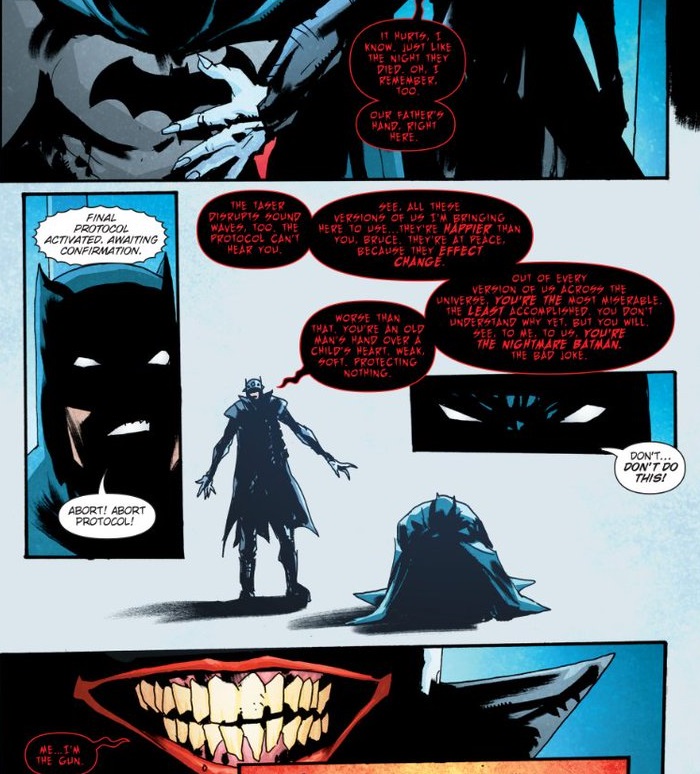
But what is The Batman Who Laughs? He was apparently a Batman who went insane after he killed the Joker. There was a toxin released in the Joker's body which drove him mad, but he would also have the same memories, abilities, and level of intelligence, all while bereft of the moral code and values he had lived by as a caped crusader. This Batman (also known as 'Metal') was simply concerned less about imposing righteous justice but more about winning. It's a terrifying hybrid of what Batman never chose to stand for and what the Joker dreamed of in his most twisted, wildest fantasies.
To be honest, a lot of the premise that still eluded me, but I'll gladly chalk that up to the fact I'm a little rusty reading and reviewing Batman comics. Hopefully, I will have more substantial stuff to say for the next issue. I know this mini series only has six, and I intend to finish them even if reviews might be slow due to other commitments. I may resurrect this blog this year with more consistent material, such as following up on my readings of Tom King's run for the flagship title, but there are no guarantees.
RECOMMENDED: 8/10
Sunday, April 30, 2017
All Star Batman by Scott Snyder issue #8
It's rather difficult to fully describe the experience of reading this issue. The narrative itself was written in the stream-of-consciousness style where Batman became prey to a rabbit-hole mind fuck courtesy of the Mad Hatter. The result of which is an odd and brilliant mixture of elements that paid little homage to Lewis Carroll's Alice stories as the inspiration while also still holding itself as its own standalone topsy-turvy. With splendid illustrations by penciler Giuseppi Camuncoli, inker Mark Morales, colorist Dean White and letterer Steve Wands, this third installment for Ends of the Earth truly is a fascinating feast for the eyes.
Mr. Freeze released a pathogen that attacked thousands of people who lost their lives in the process. Ecologist Pamela Isley (also known as Poison Ivy) agreed to give Batman a cure to prevent further casualties. But Batman, being Batman the ever vigilant, still wanted insurance that the pathogen will not grow again and infect more lives, so he goes to a residence where he encountered a formidable threat. Back in the early beginnings of Zero Year, Jervis Tetch had approached Bruce Wayne about a certain project and it would seem as if he had possessed the same strain of virus which Mr. Freeze years later.
That's why Batman followed this lead all the way back to whom he thinks is the source. There was still a matter of the Blackhawks, though, who are a unit of mercenaries seemed to determined to get in Batman's way. They even disguised themselves as the Bat-family, and Batsy was having none of that and managed to unmask the pretenders. One scene of it was done in a rather comedic way, with Batman using a mechanized flamingo to slam against the fake Nightwing. It was easily one of the most spectacular things I've seen in comics! So anyway, Batman goes down a rabbit-hole and things just get plain weird.
Friday, April 28, 2017
All Star Batman by Scott Snyder issue #7
Aside from being one of the memorable Bat-villains from the Rogues' gallery, Poison Ivy embodied female sexuality like no other fictional woman in comics, I believe, because she's also intimately connected with plant life ergo nature itself so she became unavoidably a conduit for everything feminine in its supposedly most empowering form. Nevertheless, she was still portrayed as a villain most of the time; a grand seductress with vengeful, reactionary tendencies towards anyone, especially men, who would abuse and trample on the environment which often put her in the role of a simple eco-terrorist. She cares so much about nature that she was willing to sacrifice humanity, her own race, either to sustain or improve plant life in earth.
That's her deal and to achieve writing her as a nearly sympathetic character can be a challenge for writers, and one that Synder attempted for this issue and actually succeeded, in my honest and humble opinion. The second installment of Ends of the Earth is a slow read and quite substantially just as expository as the first one with Mr. Freeze though this one also has many dialogues and discussions between Batman and Pamela Isley (Poison Ivy). Action also occurred less here and only one confrontation at the closing pages happened. Overall, the main story dealt mostly on Batman appealing to Isley to help him contain the epidemic that Freeze spread last issue. He sought her aid by personalizing it for her by telloa young girl aspiring to be an ecologist just like Isley but whose contact with the disease and subsequent death with label her only as the carrier and nothing else.
Isley, of course, would take issue on that, sympathizing with said girl but had at first didn't show it just so she can put up a strong front before Batman. What I really enjoyed about their simple yet nuanced interaction is that Batman genuinely believed that there is goodness in Isley that he knew he can connect with and even rely on, as well as the fact that he was willing to humble himself before her and admit to himself and especially to her that he cannot do this all alone and he expresses a desire to work with someone who has great knowledge about how to counter this viral attack, even if that someone is one whom the world considers nothing more but an antagonist, all for the sake of saving lives and avoiding more losses.
For the way their relationship alone was depicted for this second installment, I'm giving this issue high rating. As for the eight-paged backup story, there isn't much to say at all which was disappointing. Artist Francavilla wasn't also given that much material to work with so his usually great illustrations didn't strike as anything notable. I only liked one panel and it's about Duke Thomas and how his insecurities were spelled out by Snyder. I liked that brutal honesty at least.
Thursday, April 27, 2017
(DC Rebirth) Batman by Tom King issue #6
I found Claire a wee bit interesting here as she slowly unraveled due to the crushing weight of grief and guilt over her brother's unfortunate passing. Claire essentially began losing what little grasp she had on sanity to begin with and started talking to herself quite loudly while addressing said dearly departed sibling. What was so intriguing about King's approach here is that he also used it as an opportunity to bring about villain cameos. These villains are obscure and old enough to make the nerdiest of fans feel a sense of delight and maybe even some slight smug entitlement that they themselves easily recognized who these villains are and what issues they appeared in. I haven't been reading Batman in comics that long (I only began to seriously digest and dissect his stories since 2014 with my Bat-blog), so these references didn't click with me at all until I've done my research.
I'm not going to discuss said cameos because I'm not an authority about their appearances and I frankly didn't give a shit. I was focused on Claire because for Chrissake why would a casual reader of present comics care about her if Tom King can't make even the veteran readers in general settle down enough to give a damn about her and stop going "Oh my god, that's a cameo from an old issue back in..." or something like that? This issue's central idea is to deal with Claire's grief over the loss that was her very own doing and yet a good percentage of readers would probably rather focus on those obscure villains. It just seemed like a disservice to whoever Claire should be. She never had a fair chance even from that start and now an issue which supposedly focuses on her was also a tribute for other things. Poor Claire. That being said, I enjoyed the idea of her still going about superheroing while losing her mind in the process. Girl at least can multi-task. And then we get a nice emotional wrap-up later on.
Nice share, Bruce, but this shouldn't be about you! This issue wasn't as awful as the one that came before it. But it's not a good one either and only had a few redeemable qualities to keep it from being worse. I want to see more or Claire after this. We have been spoiled in Issue #5 that she and Duke Thomas get married so I guess she stopped using her powers and became a normal person after that because she didn't die too soon or anything. Well, that's it for Claire, I guess.
Wednesday, April 26, 2017
All Star Batman by Scott Snyder issue #6
And that's no other than the fact that DC rewrote the backstory regarding this couple. In current comics continuity, Nora was no longer Victor's legal wife; in fact she was just a woman he was pining over and so this meant that the 'love' was unrequited on his end. And it's quite frankly a disrespectfully dumb rewrite of what used to be such a moving story about a desperate husband driven to desperate measures in order to save his wife that he was willing to cryogenically freeze her for a while until there was a cure for her disease. Nora was Victor's last piece of humanity; the only one who can possibly thaw the ice in his heart once she is awaken. To remove the 'married couple' dynamic from their story now reduces Mr. Freeze as nothing more than a deranged stalker willing to do whatever it takes to gain the affection of a woman whom he has no personal history with unlike in the story as featured in Batman: The Animated Series, Heart Of Ice. That remains to be hands-down the best Mr. Freeze origin story.
I don't know why DC rewrote what Victor and Nora had; I mean, at least the show Gotham had the decency to keep their marriage intact in their own version of Mr. Freeze's origin story. What I will tackle about instead was how Snyder managed to 'fix' this rewrite by claiming that in symbolic spirit, Nora is Victor's 'wife'. If you have no idea about the rewrite, this won't even register as an odd choice of phrase because I bet the version that most Batman fans know about Mr. Freeze is the one they have watched take place in Heart of Ice. Anyway, I like how Snyder wrote this issue strictly more in narrative form than in dialogues. The exchanges mostly happen in narration boxes so everything is expository in that sense. And I think it worked brilliantly, especially since Jock was the artist who brought to life some of the most creepy panels ever put in a comic book's pages. His art style has such a seething horrific yet subdued vibe that looking through them can give someone chills.
That revelation at the end pertaining to how Batman duped Mr. Freeze was so out-of-this-world it was a proud mark of genius. Sure, it's disconcerting that Batsy would attempt something so fatal to his life but that's just part of how Batman usually operates so it shouldn't be that much of a shock. I definitely enjoyed this issue at last. I think it's the finest of what has come out from this title so far. I read that the next issues would be standalones like this one and would feature Poison Ivy, Mad Hatter and Ra's Al Ghul.
The second cycle of The Cursed Wheel story also fared better than I would have counted on. Yet another artist (Francesco Francavilla) managed to make it work. He had very interesting choices for panel layout and the visual impression that was created is one that for me fits the overall 'enigmatic' charm that is the Riddler. Much like the main story, this was relied on exposition which I had no problem with because it actually took the time getting readers into the story's fundamentals unlike the first cycle. Duke Thomas is once again the focal point of the story alongside the bad guy Riddler and this I hope becomes consistent because I'm slowly warming up to the idea of Duke becoming a part of the Bat-family and I'd like to see how he holds himself up to that pedigree. So in a nutshell, issue #6 had been a very impressive installment.
Tuesday, April 25, 2017
(DC Rebirth) Batman by Tom King issue #5
Friday, April 21, 2017
All Star Batman by Scott Snyder issue #5
Thursday, April 20, 2017
(DC Rebirth) Batman by Tom King issue #4
![]() |
| Now that is some heavy Break-The-Cutie stuff |
Wednesday, April 19, 2017
All Star Batman by Scott Snyder issue #4
Tuesday, April 18, 2017
(DC Rebirth) Batman by Tom King issue #3
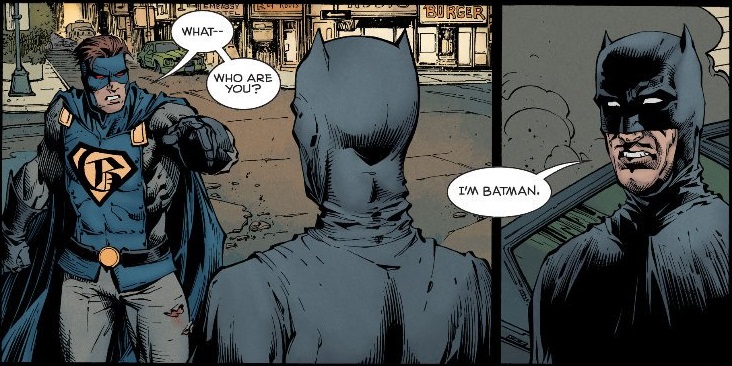
It was a victory that was satisfying on an emotional level because of how much it means for Bruce Wayne as Batman to save even just one life in the hands of a petty crime. Most people forget that Batman was always about stopping street-level crimes. His night patrols were always composed of impeding organized crime or even the smallest crime committed in some alleyway in Gotham. Tom King showed us that in this flashback and reminded us that behind the Dark Knight will always be that traumatized boy who lost his parents one bad night where it changed the course of the rest of his entire life afterwards, and in becoming Batman he was channeling this loss into something demonstratively righteous and inspiring. He may not have been able to save his parents, but he can symbolically avenge their deaths by ensuring no one will ever lose their loved ones the same way he did particularly in cases where a tragedy can just happen in the most mundane way possible such as during a late-night mugging.
Speaking of inspiring life-changing events, let's talk about these specific panels for a moment:
I'm sorry, but I was in goddamn tears right after reading this. How could I not be, seeing as how much Batman is my own childhood hero whose brand of justice and truth resonates with me to this day? Watching him prevent the same crime that claimed his parents' life was cathartic, and being able to talk to the boy who could have been him was a rather powerful moment. Later on, the readers will discover that this flashback sequence was about Hank Clover (and to a lesser extent, his sister Claire) who will become the superpowered fans named Gotham and Gotham Girl. This was their origin story which Bruce found out by himself while he was in FBI disguise to interview their parents who were more than eager to share their children's aspirations to become defenders of the city since they have been motivated and inspired by no other than Batman.
It was all the more reason why I was so moved about those panels above because I feel as if this was Batman not only speaking to Hank Clover as a young boy but also speaking to his child-self. These were the words he wished someone had said to him when his life changed after witnessing his parents' brutal murders in front of him, and he had no idea how to start picking up the pieces just yet. This was Bruce Wayne now as an adult and a vigilante wishing to reassure a kid just like him from before that hope blooms even in the most wretched of places, and that he doesn't have to stay powerless forever because one day he may even get the chance to fight back and rise from the adversity of his own fears and insecurities. That's the message a hero like Batman imparts and one that people should never forget or tarnish. This is why we read his story. At the heart of it all, this is about one man's victory over his own demons every time he becomes Batman and defeats his enemies. He is an inspiration.
Just ask Hank and Claire Clover. They decided to become Gotham and Gotham Girl because of him.
I was really happy about this issue because it humanized Hank and Claire and gave them convincing character motivations. I readily accept that they are simply noble and decent people who just want to give back to their city and help anyone who needs a hero at the end of the day. That fateful meeting between Hank and Batman that night was a hallmark for the former who found a role model to emulate and an altruistic purpose to share with his sister. It's so beautiful and I dread how they're going to be broken down once Hugo Strange and his Monster Men get to them. I know it's going to happen and I can only hope they survive the ordeal because at this point it has become rather easy and natural to root for these kids. Earnest idealists who want to do good being thrown into a gritty situation never fails to break my heart. The next issues are bound to get crazy and sad.